Why SEO Means Long-Term Stability
If you run a small café, a salon, or even a local repair service, you’ve probably noticed how unpredictable marketing can be. One month, a Facebook ad might bring in a rush of customers, and the next month—silence. Paid ads are like renting attention: the moment you stop paying, the visibility disappears.
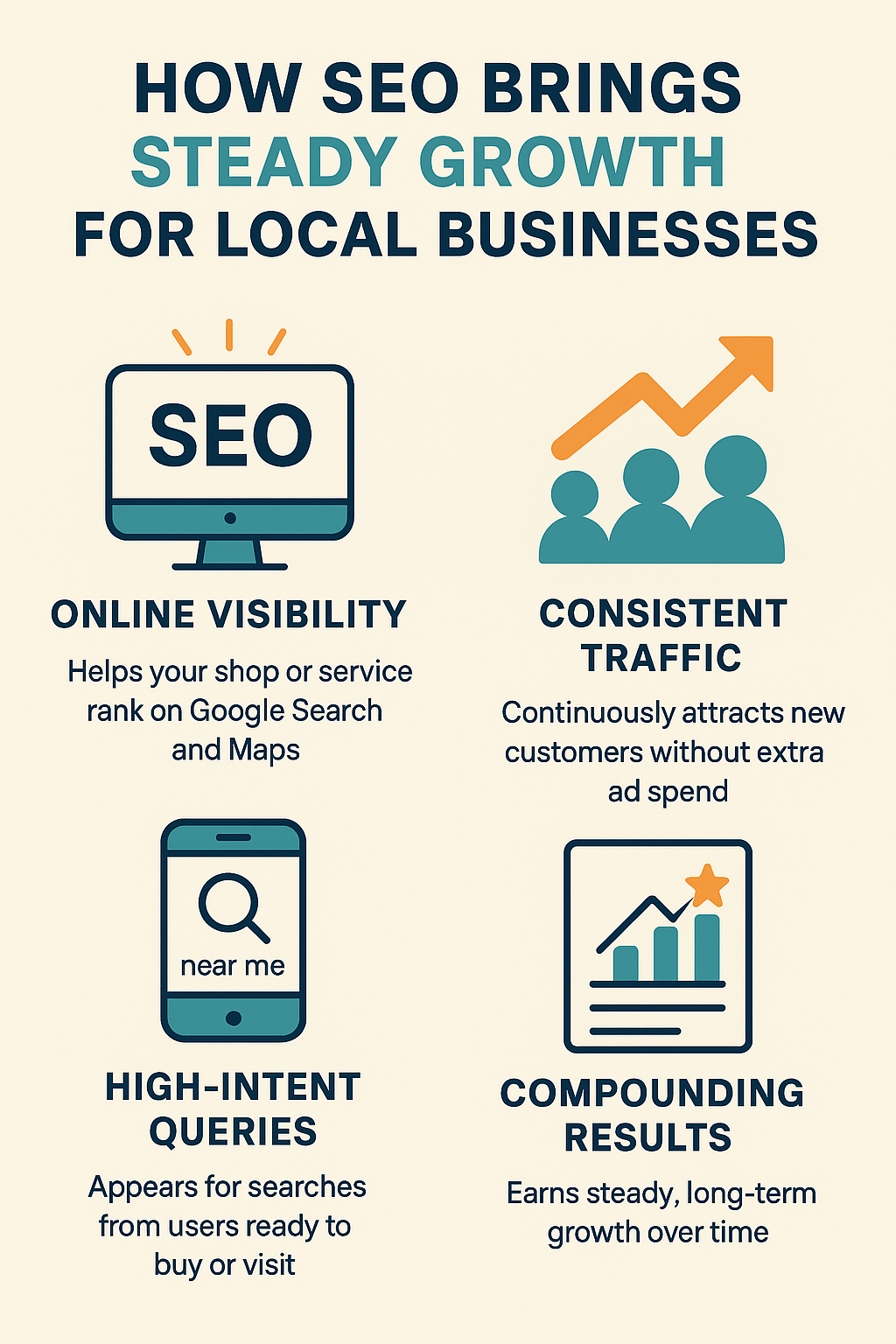
SEO works differently. Instead of chasing short bursts of traffic, it’s about laying down roots online. When your business shows up on Google Search and Maps, you’re not just catching random clicks—you’re becoming part of how your community finds what it needs every day. People searching “best coffee near me” or “AC repair in Indore” aren’t just browsing; they’re ready to buy, visit, or call.
That’s where the long-term magic happens. The time and effort you put into optimizing your website and business profile don’t vanish once the campaign ends. They keep working for you, week after week, month after month. SEO is less like renting a billboard and more like owning a prime location on the busiest street in town. Once you’re there, customers keep walking in—without you having to keep paying for every click.
1. Why Local Businesses Gain the Most from SEO
Local search queries such as “best café near me” or “AC repair in Indore” have high
intent—people are ready to buy or visit. Ranking high on those searches means immediate
conversions.
Unlike national SEO, local SEO focuses on your nearby customers, Google My Business profile,
and local keywords. It is faster, more affordable, and sustainable for long-term growth.
2. Foundations That Make Local SEO Work
A. Fast, Reliable Hosting
Your website’s loading speed affects both ranking and user experience. Hosting services such
as Rankoq.com offer fast, optimized servers specifically for small and local businesses. Reliable
hosting ensures your site stays up and loads quickly on any device.
B. Mobile Optimization
Most local searches happen on phones. Your site must look perfect and load under three
seconds on mobile. Platforms such as SimpleHyped.com/local-business provide pre-built
mobile-friendly templates for cafés, salons, clinics, and service providers who want to get online
fast.
C. Sitemaps and Crawlability
Search engines need clear navigation paths. Use tools such as mysitemaps to generate a
simple XML sitemap. Submit it through Google Search Console so crawlers can easily index
your pages.
D. Testing Contact Forms
Imagine this: a potential customer fills out your website’s contact form to book an appointment, but the message never reaches you. That’s lost business right there. Before you launch your site, always test your lead forms to make sure they’re actually working.
One simple trick is to use a temporary email address instead of your personal inbox. Services like 10Minutesmail let you generate a disposable email in seconds. You can enter it into your form, check whether the confirmation arrives, and see the exact customer experience—all without cluttering your real inbox or exposing it to spam. It’s a quick way to test, tweak, and make sure your leads are flowing in smoothly.
E. Clean Design and No-Code Setup
Of course, once your forms are tested, the next step is making sure your website looks clean and professional. If you’re using WordPress, plugins like ProElementss make it easy to design no-code, SEO-friendly pages that load fast and stay visually appealing. The combination of reliable design and tested forms creates a polished experience that builds trust with your visitors.
3. How SEO Converts Searches into Customers
1. Visibility: Google My Business listing plus optimized service pages help you appear in “near
me” results.
2. Trust: Reviews, consistent contact info, and schema markup show legitimacy.
3. Engagement: Fast pages, clear CTAs, and click-to-call buttons drive contact.
4. Loyalty: Repeat customers leave more reviews, building even higher rankings.
SEO creates a self-reinforcing growth loop: traffic → reviews → higher ranking → more traffic.
4. Content that Keeps You on Top
Google values useful, updated content. Post blogs about your locality and expertise:
● “5 Best Summer Coolers in [Your City]”
● “How to Maintain AC Units Before Monsoon”
Such pages attract nearby readers and build authority. Write naturally and include your city
name to signal relevance.
5. Local SEO Checklist
● Title Tag: Service + City (e.g., “Salon in Pune | Luxury Makeovers”)
● Meta Description: Encourage clicks with a local touch
● H1 Heading: Matches intent
● Schema: Include LocalBusiness markup
● Speed: Test and compress images
● Sitemap: Generate on mysitemaps.com
● Hosting: Choose Rankoq for fast performance
6. Long-Term Tracking Metrics
Measure progress every month :
● Organic clicks & impressions
● Google Map views
● Calls from website buttons
● New reviews & ratings
Improvement in any of these areas signals that SEO efforts are compounding.
Conclusin
Think of SEO as owning a prime spot in your city’s busiest marketplace. Paid ads are like renting a billboard—effective while you’re paying, but gone the moment the contract ends. SEO, on the other hand, is digital real estate you own. Every optimized page, every review, every blog post builds equity that keeps paying you back long after the initial work is done.
For local businesses, this means stability. Your bakery, salon, repair shop, or clinic doesn’t have to constantly fight for attention with expensive ads. Instead, your presence on Google Maps and search results becomes a 24/7 storefront, always visible when someone nearby is ready to buy.
Yes, SEO takes patience. But the reward is compounding growth—steady traffic, trust that deepens with every review, and visibility that can’t be turned off with a missed payment. If consistency and long-term stability matter to your business, SEO isn’t just a marketing tactic—it’s the foundation for sustainable success.